.png)
When the vendor starts doing what you do, pay attention
Eleanor Dorfman, Head of Industries at Anthropic, gave a talk recently that most people will read as a behind-the-scenes look at how a fast-scaling AI company rebuilt its go-to-market motion (you can watch it here). It is that. But for HubSpot partners and revenue consultancies, it's also something else: a detailed blueprint of where enterprise buyers are heading, and what they're going to expect from the people they hire to help them get there.
For context, Anthropic's commercial demand went vertical after the launch of Opus 4.6 in December 2025. They just couldn't hire fast enough and they certainly couldn't onboard fast enough, either. So they made a different call and chose to rebuild the sales motion itself, using the tools they already had, with Claude threading through all of it.
The result was an AI-native GTM function built in weeks.
It wasn't a new stack
Whilst I was watching the video, Eleanor said "it's [about] being intentional about your existing stack."
Anthropic, even though their budget is probably limitless, didn't go out and buy a set of AI-native tools to replace what they had, but rather they leaned into Clay, Salesforce, Gong, Ironclad, Intercom, Slack, all platforms that have been standard infrastructure for enterprise sales teams - and for their teams - for years. What changed was the connective tissue. Claude became the layer that made those tools talk to each other, pulled context across them, and surfaced it to the right person at the right moment.
Which is a significant signal for anyone advising businesses on their revenue infrastructure. The question businesses should be asking isn't "should we adopt AI?", it's "how do we make AI work across the systems we've already built?" That's a fundamentally different problem, and one that requires a different kind of partner to solve it.
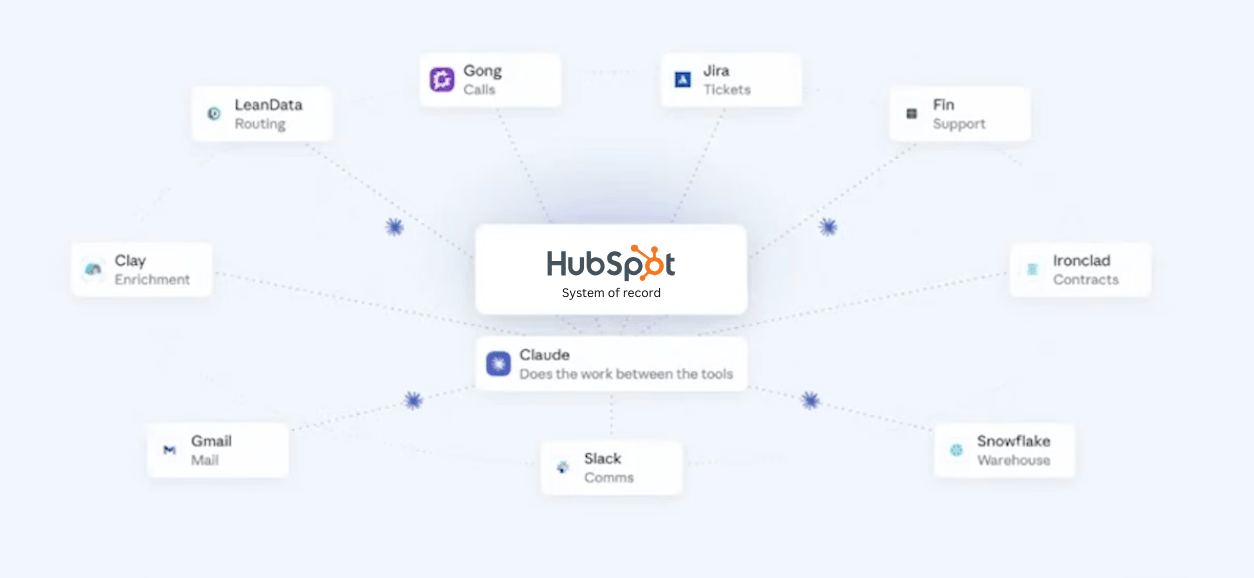
The qualification → funnel split
One of the more striking data points from the talk was that 54% of Anthropic's new enterprise logos in 2026 came through a self-serve funnel; fully provisioned, on real contracts, with onboarding enrolled, no AE involved. A year ago, that would have been unthinkable for enterprise software.
The mechanics are straightforward: Claude and Clay qualify every inbound lead, then route them into either a self-serve flow or a human sales funnel. What's notable is that self-serve isn't a downgrade, it's a deliberate path for buyers who don't need or want an AE involved.
For HubSpot partners, this has a direct read-across. The quiz-based or diagnostic-led acquisition model - where a tool qualifies intent and routes buyers accordingly - isn't experimental anymore. It's being proven at scale by one of the most watched companies in enterprise software. The infrastructure to do this in HubSpot already exists: forms, workflows, lead scoring, lifecycle stages, smart CTAs. What's typically been missing is the strategic design and the willingness to trust a non-human qualifier for high-value accounts. But that reluctance is harder to defend now.
Sales leaders are becoming systems thinkers
Eleanor said this quite bluntly, and it's true beyond sales: "Sales leaders are rapidly becoming systems thinkers over deal strategists."
The same shift is underway in marketing. Managing a campaign calendar is no longer the job. The job is designing the system that ensures the right person gets the right message at the right time, that activity is attributed correctly, that the CRM reflects reality, and that the data flowing into revenue conversations is trustworthy.
That requires a different set of capabilities and a different kind of support. Businesses that are operating with a HubSpot partner primarily for campaign execution or portal management are going to find that relationship increasingly misaligned with where the pressure is actually coming from. The pressure is coming from the revenue conversation: why is pipeline thin, where is the bottleneck, what does the data actually say.
What this means in practice
A few things stand out from the Anthropic model as directly transferable for the businesses we work with:
The morning brief concept: a single prompt that surfaces everything that needs attention across email, CRM, calendar, Slack, and calls, is achievable today for HubSpot users with the right connector setup. The infrastructure question is less about technology and more about what data is clean enough and structured enough to be useful when surfaced. Which is, again, a foundations problem.
The "encode your best people's practices as skills" model maps directly to how most of our clients think about their RevOps or sales playbook. The barrier has always been adoption - getting reps to follow a process consistently. If the process comes to the rep rather than requiring the rep to go and find it, that adoption problem looks very different.
The deal support model: making Slack the front door for legal, deal desk, and compliance approvals, with Claude triaging and either resolving or escalating is a version of what many HubSpot clients need for their internal handoff processes. Marketing to sales. Sales to CS. Proposals to legal. These handoffs are where deals slow down and customer experience degrades. Making them systematic rather than relationship-dependent is where a lot of the recoverable revenue sits.
The honest implication
Anthropic rebuilt a significant part of their go-to-market function in weeks because they had clean data, a coherent tech stack, and clear processes they could encode. That speed was only possible because the foundations were in place (sound familiar?).
Most of the businesses we talk to don't have that. They have a CRM that partially reflects reality, lead routing that was set up two+ years ago and hasn't been revisited, attribution that breaks at the handoff point, and a HubSpot portal that's accumulated three years of workarounds...that's not a criticism, it's just where most growing businesses are.
The distance between where most businesses are and what Anthropic pulled off isn't really an AI problem. The AI is weirdly the easy part. It's the years of inconsistent data, unmaintained processes, and accumulated workarounds that make it hard to move quickly.
It's a solvable problem - but it has to be solved first.
If this article has raised some questions for you, please don't hesitate to get in touch.