Half of your executives are making major decisions on data they don't trust. AI is about to make that much worse.
The numbers are in, and it's not looking good...
A new study by OneStream, surveying over 350 senior Finance and IT executives across the US, UK, and France, found that nearly half (47%) admitted to making a material business decision in the past year based on inaccurate, incomplete, or outdated financial data. More than one in three reported losses exceeding $1 million as a direct result.
At the same time, Gartner forecasts global AI spending will hit $2.52 trillion in 2026, a 44% increase year-on-year.
Put those two facts next to each other and the problem becomes clear. Organisations are scaling AI investment faster than they're fixing the data it runs on.
The confidence gap
The worrying part is that most executives don't think they have a problem.
79% of those surveyed said their data governance was strong enough to support large-scale AI adoption. 85% reported having a formal governance programme either in place or underway.
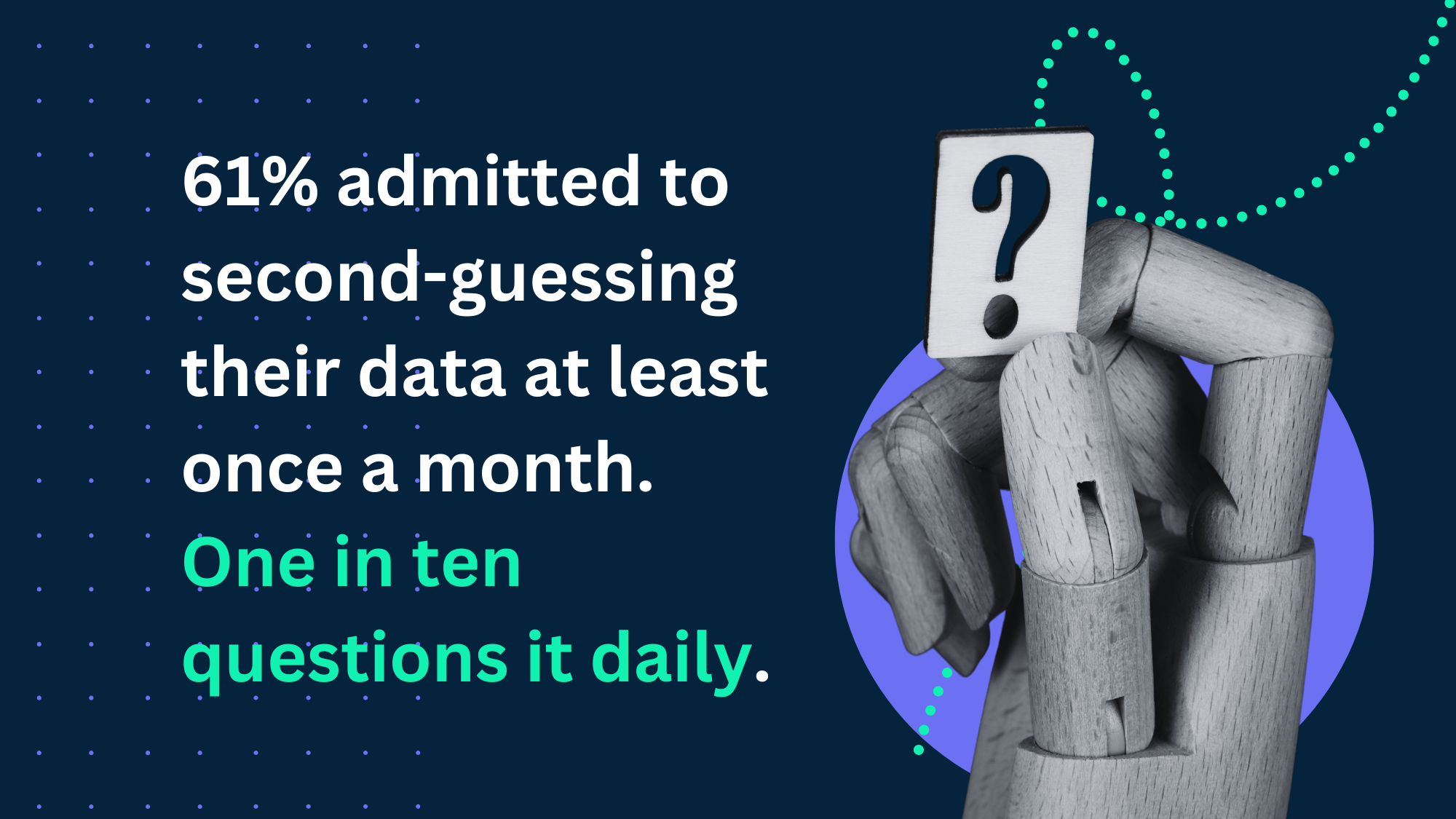
And yet nearly two-thirds (61%) admitted to second-guessing their data at least once a month. One in ten questions it daily.
That gap between stated confidence and lived reality, is where the real risk sits. Governance frameworks look good on paper. Trust in the actual numbers is a different question entirely.
OneStream's CEO put it plainly:
"Unless companies have data they can trust, AI will only accelerate and amplify bad decisions."
That's not a warning about some future state, it's a description of what's actually happening now.
AI doesn't fix bad data.
There's a widespread assumption that AI will surface data problems, that it will flag anomalies, reconcile discrepancies, alert you when something looks wrong. Sometimes it does, but more often, it doesn't.
AI models are trained to find patterns and generate outputs. If the inputs are inconsistent, incomplete, or structurally broken, the model works with what it has. It doesn't pause to tell you your pipeline data hasn't been updated in six weeks, or that two teams are using different definitions of a qualified lead. It produces an answer confidently, and the answer looks authoritative.
and that's the compounding risk. Bad decisions made on bad data used to be slow. A human working through a spreadsheet has natural friction; they'll notice when something looks off or they'll ask questions... everything is...slower. But AI removes that friction. We're expected to complete so much more in the day because AI makes it "easier" to do so, but it also removes the natural checkpoints and those checkpoints are crucial.
Gartner's framing is worth noting here: their January 2026 forecast places AI in the Trough of Disillusionment throughout 2026. The phase where early excitement gives way to harder questions about ROI and reliability. Boards are getting more sceptical. The pressure is on to demonstrate that AI investment is producing outcomes, not just activity. That pressure lands hardest on organisations whose data foundation wasn't ready for the scrutiny.
The generational dimension
Another thing that was really interesting was that OneStream found that younger executives, ie. those aged 25 to 44 are the heaviest AI users, with over 82% using three or more AI tools for decision-making, compared to 69% of their more experienced peers.
They're also the most exposed. More than half (51%) report making a material decision based on faulty data, versus 39% of older leaders. They're four times more likely to report significant financial or compliance consequences as a result.
So far, not so surprising.
It's easy to read this and think that younger leaders are less careful but the more accurate read is that they're missing something that can't be downloaded: the accumulated pattern recognition that comes from years of doing the job without AI assistance. In days gone by execs would have spent years working their way up, learning the ropes and reading and revising the data like their lives depended on it.
A finance director who spent a decade building forecasts manually develops a feel for when a number looks wrong. They know what a healthy pipeline looks like because they've watched hundreds of them. They have the confidence, and the professional standing, to push back when something doesn't add up.
That institutional knowledge doesn't exist yet for people early in their careers, especially those entering roles where AI is already embedded in the workflow. They haven't had the chance to build the baseline. And increasingly, they're not expected to, they're expected to do more, faster, because they have "better" tools.
Which raises a question the industry isn't answering cleanly: when AI produces a flawed output and a junior executive acts on it in good faith, who carries the consequences? Not the model. The accountability, in practice, lands on the person. The expectation of competence remains human even when the work is increasingly machine-assisted.
That's of course not an argument against AI adoption, or against hiring people early in their careers. It's more just highlighting the importance of treating data governance as the thing that protects them, as much as it protects the business.
The Finance and IT misalignment hiding in plain sight
There's a structural problem underneath all of this that the research makes visible.
89% of executives claimed Finance and IT are aligned on data governance. But when you look at who claims to lead it: 85% of CIOs say they do, while 78% of CFOs say the same.
But that isn't alignment.
That's two teams running parallel programmes with different priorities and, in all likelihood, different definitions of what "good" looks like.
The consequences are measurable; as CFO Dive reported, organisations where Finance and IT are genuinely aligned and not just co-existing, are 5.5 times more likely to report complete trust in their data.
That's a crazy multiplier, that isn't coming from better technology, but from shared ownership and shared definitions.
What this means in practice
CRM and revenue data sits at the centre of this. It's where Finance pulls forecasts, where Sales tracks pipeline, where Marketing measures attribution. It's also one of the most structurally fragile datasets most organisations hold. Built incrementally over years, by different teams, with different rules, and often with no single source of truth.
When AI is layered on top of that, whether that be for forecasting, or for lead scoring, or revenue attribution... it inherits every inconsistency in the data beneath it. The outputs look precise but the underlying reliability is a different matter.
The path forward isn't to slow down AI adoption - you'll quickly be left behind in a world that is moving faster than you can type "AI" but it's making sure that, that path is paved in good data. Do the governance work in parallel, not after the fact. That means establishing what good data looks like, who owns it, how it's maintained, and where the authoritative version lives. It means Finance and IT building that together, with clear accountability, not two separate frameworks that nominally coexist.
It's not the most glamorous work, but it's certainly the work that determines whether AI delivers what the investment promises.
We're running an event on exactly this
On 17th June, we're bringing together revenue and operations leaders to talk about what it actually takes to build infrastructure that earns trust, from data foundations to workflow automation to the systems that connect them.
If this article has surfaced questions you're already sitting with, it's worth being in the room.
Sources: OneStream study, May 2026 · CFO Dive, May 2026 · Gartner AI Spending Forecast, January 2026